MODULE LEADER
Javier Jia
Innovative Product Development
Oxford Brookes College
Chengdu University of Technology
PGCiEPMP Certified
Focus: Agile Delivery, Product Discovery, Systems Thinking
CHC5056 INNOVATIVE PRODUCT DEVELOPMENT
From a user problem to a product
worth developing.
This module connects product development, teamwork and professional practice. You will learn to explain decisions and support claims with evidence. Use the arrow keys or the buttons to navigate. Open Contents to jump to a page; copy the address to share a specific slide.
Guiding your journey from user discovery to working product.
Innovative Product Development
Oxford Brookes College
Chengdu University of Technology
Leading lectures, moderating Sprint Reviews, and supporting your team as you iterate from an uncertain problem to a working product.
Curiosity, weekly sprint momentum, open team communication, and grounding product choices in concrete user evidence.
Available during weekly seminars and scheduled office consultations. Bring questions early rather than waiting for milestones.
Javier Jia leads CHC5056 Innovative Product Development at Oxford Brookes College, CDUT. He holds PGCiE and PMP credentials. Reach out during weekly seminars, office hours, or via university channels for academic and project guidance.
Hypothetical teaching scenario: Campus advice service
The pilot outcome is invented for this teaching scenario. Option B has a clearer connection to the stated waiting problem. Its value still depends on evidence, reliability and whose needs it serves. A larger feature list alone does not establish value.
Explain how product development, teamwork and professional practice connect.
Identify assessment milestones and individual and team responsibilities.
Distinguish product features, user problems and intended benefits.
These are the three Lecture Learning Outcomes. The exit check returns to them. Today introduces adaptive delivery through an example; detailed Scrum mechanics and planning methods come later.
Practise the technical judgement, teamwork and responsibility needed for Level 6 project work.
A shared product does not make individual responsibility disappear. Contribution evidence can include an implemented change, a design decision with reasons, or a recorded test and its findings. The formal assessment briefs specify the evidence requirements.
Explore needs
and shape an idea
Part A
proposal
Sprint
Review 1
Part B +
Sprint Review 2
Sprint
Review 3
Sprint
Review 4
Sprint Review 5 +
Part C
Final verification
and module review
In-person Class Test: centrally scheduled outside normal teaching. Date, time and venue to be announced.
The journey combines product work, feedback and reflection across the year. Part B and Sprint Review 2 share the S1 Week 12 seminar session but are separately assessed. S2 Week 12 final verification adds no mark. The Class Test is not held in the normal Week 12 lecture.
Justify a computing product proposal.
S1 Week 5Communicate the team’s product and project.
S1 Week 12Evidence professional development.
S2 Week 11Demonstrate module understanding.
Centrally scheduled · details to be announcedFive Reviews × 8%
Each Review: Group /40 + Individual /60
Part D totals 50%: five Sprint Reviews at 8% each, plus the In-person Class Test at 10%. Reviews take place in S1 W10, S1 W12, S2 W5, S2 W8 and S2 W11. The Class Test is centrally scheduled; date, time and venue will be communicated separately. The Part A Defence clarifies understanding where required and has no separate numerical mark.
of the module
Begin with a specific user and problem.
Explain why the proposed product is worth investigating.
Use the mandatory Project Proposal Template provided with the current brief. The exact submission date is published on the student website. Today introduces the purpose and first preparation steps; the Seminar explores the brief and rubric. Your Four-Line Idea Card today is formative, and you are not committing to a final product idea.
Work with a neighbour. Match each example to its primary assessment purpose.
Explain the purpose of each match. Some project evidence supports more than one assessment, but their criteria remain distinct.
This is a formative matching exercise, not an assessment question. Discuss the purpose before checking the explanation. In particular, distinguish communicating the group project in Part B from demonstrating product and individual contribution evidence in the Sprint Reviews.
Finishing the work does not, by itself, prove that users benefit.
A project has a defined purpose and a beginning and end. A product can continue to be used and improved after a particular project ends. In computing, a product can be software, a system or a service. The same distinction applies to the campus queue example.
Students wait at the desk because they do not know when they will be called.
These are intended effects in a teaching scenario. Evidence is needed to establish whether they occur.
A feature describes something a product can do. An output is a delivered result, such as the implemented alert. An outcome is a change resulting from use. A benefit is an improvement valued by a stakeholder. The chain is a hypothesis until evidence supports the connections.
Stakeholders can value different changes. An alert sent too early might reduce time at the desk but increase missed appointments. These are hypothetical effects. Check outcomes for affected stakeholders rather than choosing a single convenient success measure.
Use each label once: project, feature/output, outcome, benefit, assumption.
Statement 3 needs observation; statement 5 needs investigation. Correct this claim: “Sending an alert proves that students benefit.”
The statements describe a hypothetical product; they are not verified findings. An outcome is a change, while a benefit explains why the change matters. The claim about returning in time is an assumption that could fail even when the alert feature works.
A promising idea still contains unanswered questions.
An uncertainty is something we do not yet know. Name it explicitly rather than burying it inside a feature list. Useful evidence could come from observation, service records, interviews or a small trial. Detailed requirements discovery begins in Week 2.
Assumption: students can return in time.
The alert arrives, but the timing is wrong.
Check waiting time and missed turns again.
Adaptive delivery still involves planning. Evidence helps us revise it.
The trial is hypothetical. When important needs or solutions are uncertain, a small step can expose a weak assumption before extensive development. A predictive approach plans more of the work in advance where requirements are sufficiently understood; this example illustrates why an adaptive approach can help. It does not require detailed Scrum knowledge.
“An AI app for students.”
5 MINUTESWhich students, in which situation?
What difficulty do they experience?
What improvement would matter?
What do you still need to find out?
Keep this Four-Line Idea Card for your Seminar. Identify a possible benefit, not a promise that the product will succeed. No final project choice is assessed in this lecture. Give peer feedback on specificity and reasoning, not on how technically impressive the idea sounds.
Read the Part A brief and rubric.
Bring one example of a skill you have used, and one question.
From Idea to Requirement
Investigate needs. Challenge assumptions.
Use the three exit questions to check the Lecture Learning Outcomes. Your individual skills baseline is developed in the Seminar using examples from previous work. Keep one unresolved question alongside your Four-Line Idea Card. The current Module Guide and assessment documents on the student website remain the source for formal requirements.
Unleash your entrepreneurial spirit: open to all students across all programmes.
“If any of you wish to know how to kick off a startup, or just curious about entrepreneurship, please join the boot camp or just contact Maciek.”
Teams of 3 to 4 people. Shape your business idea.
Deadline: 31.12.2026
Submit a summary of your venture proposal.
Deadline: 26.02.2027
Hands-on work with mentors to refine your business.
Date: 16.04.2027
15-minute presentation to convince the judges.
Date: 17.04.2027
Scan the WeChat QR code on the poster to join the group.
Contact Maciek: maciek@zy.cdut.edu.cn
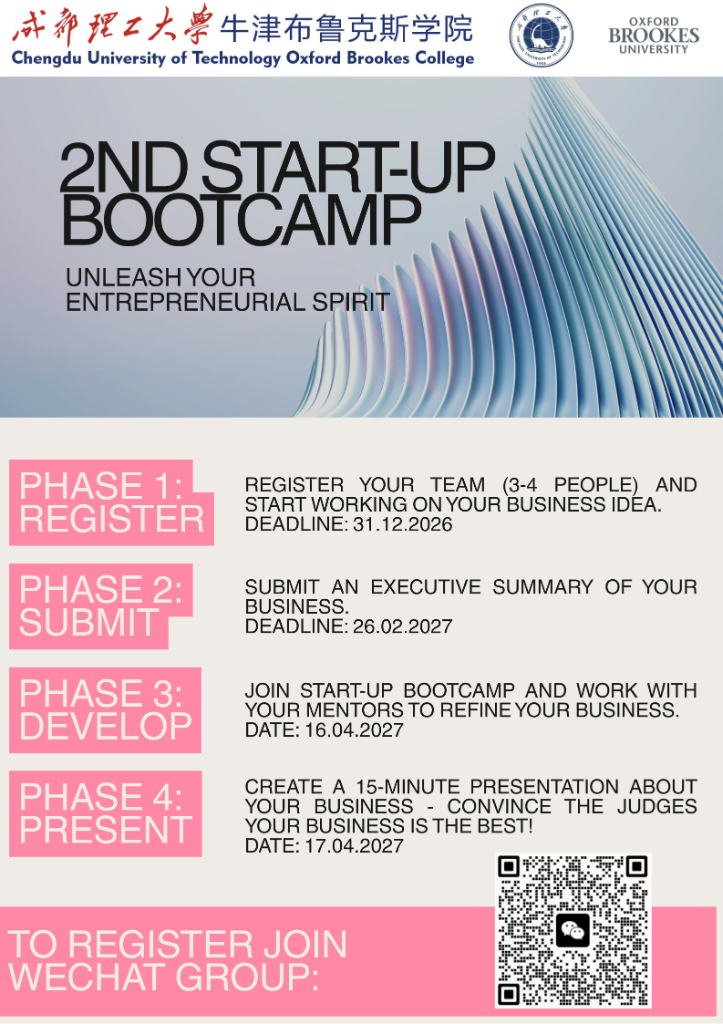
The 2nd Startup Bootcamp runs across four phases from team registration in December 2026 through the final pitch in April 2027. Teams of 3 to 4 students are welcome from all degree programmes. Scan the WeChat QR code on the poster or contact Maciek at maciek@zy.cdut.edu.cn.